
Learn the Science of How to Create Comfort No Matter the Weather
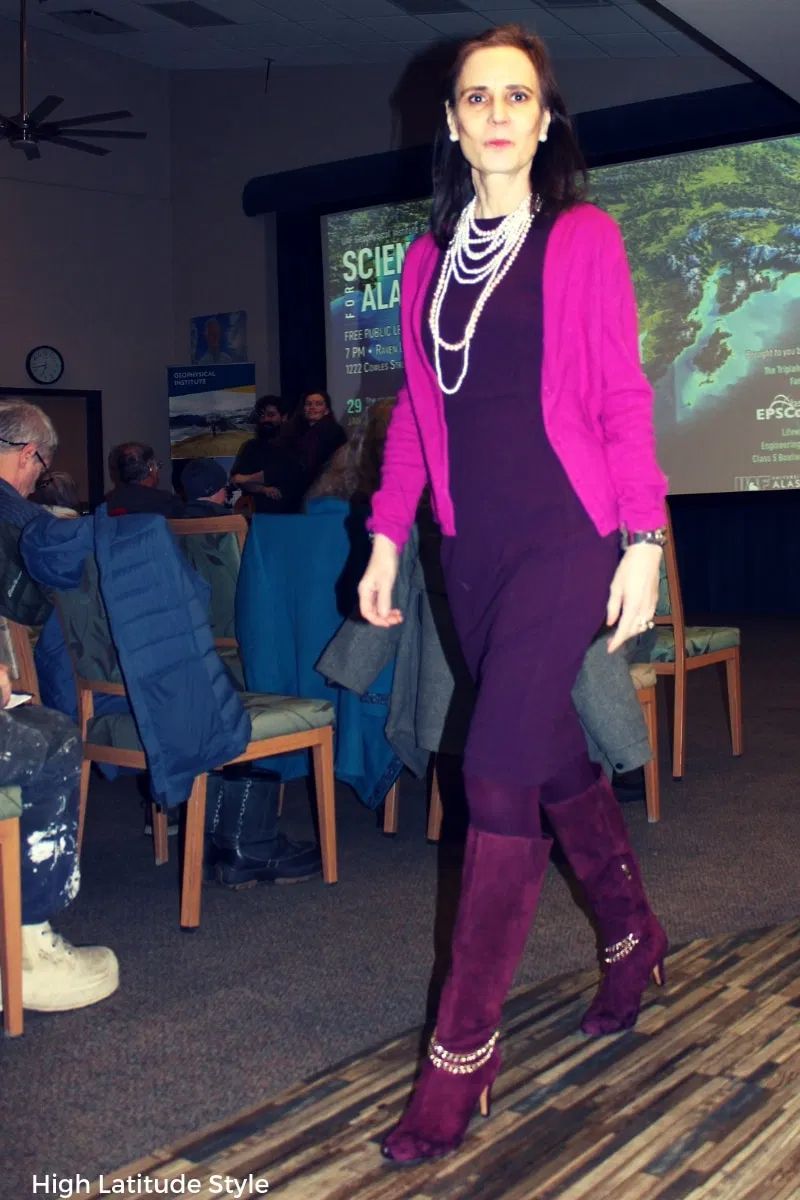
Nicole Molders, owner of the blog High Latitude Style, is an Emerita professor of atmospheric sciences and scholar, retired from the University of Alaska – Fairbanks. She combined her interests in science and fashion in her book Discover the Relation Between Fashion, Fabrics, Weather and Comfort. In it, she explains the science of how to create comfort no matter the weather. She is proof that age doesn’t matter.
Book Tells How to Create Comfort No Matter the Weather
As one would expect from a professor, this book is similar to a scientific treatise on fabrics and how they affect our comfort in all climates. It’s possible to use this book as a reference when choosing the most comfortable clothes for heat, cold, windy and wet weather conditions.
In the prologue, the author explains:
“This book is for everyone interested and/or engaged in the fields of textiles, fashion, fashion design, thermal comfort and/or weather, especially meteorologists, bioclimatologists, engineers, technologists of the textile industry, apparel salespersons,…high school students interested in the STEM field and laymen. The book can also serve as a textbook for a 100-level science class for non-science majors, especially for fashion design and fashion majors, in community, technical and fashion design colleges, as well as universities.”
At a time when so many people are interested a more sustainable wardrobe, they can benefit from knowing the attributes of all types of fabrics. When introducing her book to me, Nicole wrote:
“…blindly buying clothing made from renewable-source fabrics may easily lead to a full closet of durable, long-lasting, high-quality clothes. However, those clothes may be totally unsuitable for the buyer’s climate. The result is wasted money and resources because a sustainable wardrobe also means that the buyer really gets a lot of wear out of the clothes. This is only possible when the clothes provide thermal comfort appropriate to the weather in the buyer’s climate. This point is too often overlooked by both sellers and customers.”
What’s in the Book?
In …The Relation Between Fashion, Fabrics, Weather and Comfort, the author teaches about clothing behavior so that we can choose the most effective fabrics for warming up and cooling down, depending on the weather. She compares the properties of natural, regenerated and synthetic fabrics (which surprised me because before reading this, I had generally assumed that human-made fibers were inferior to natural ones – especially for sensitive types like me.) And she wipes out myths about dressing for the weather, including the details of how color affects our comfort in cold and hot conditions.
The book begins with a history of clothing invented for cold, snowy climates; for humid, rainy, temperate weather; and for beating the heat. Then she describes natural, regenerated, synthetic and blended fibers and which ones improve your comfort in these varying weather conditions according to the laws of thermodynamics.
Next came an in-depth explanation of sun-protective fabrics.
After that, is an exploration of clothing insulation and heat transfer.
Following that, find out how humidity, rain, wind and extreme temperatures relate to thermal stress and comfort.
“At temperatures below -22F (-30 degrees C), even when acclimated to cold weather and when wearing the best extreme cold weather protective clothing, inactive people will not achieve thermal comfort at all. The clothing just provides insulation and serves for short-term protection.
This fact is just another reason not to throw fashion out of the window when the Polar Vortex moves far south. You just cannot achieve thermal comfort at these temperatures. Period. But at least you can feel uncomfortable in style.”
I found the section on color, fashion and wear comfort especially interesting. For instance, there is an in-depth explanation for why black feels more comfortable in hot climates than white.
Another really good reference section of this book is where it presents the typical weather of the earth’s climate regions and then reveals what is best to wear in these regions.
After reading this book, you should be able to judge the thermal comfort of garments by reading the clothes tags.
At the end of the book, the author points out the needs for future developments and research directions for the next generation of engineers in the clothing industry. This includes upcoming career opportunities in sustainable processing of natural fibers and research for inventing advanced radiative textiles. Nicole points out that global warming will require the development of fabrics that are antibacterial and that protect from insect bites. Any inventors in the fashion field out there?

Buy Discover the Relation Between Fashion, Fabrics, Weather and Comfort HERE or HERE.
Let’s Connect
Does this book sound interesting or helpful to you? I’d love to hear from your thoughts. Please leave a reply in the comments below!
Like this post? You might like to read more of my book reviews HERE.
Do you have a friend who would like this? Please use the Share buttons.
Never miss a post! Get new content each week by email. Send your request by clicking “Subscribe” in the form at top, or fill out the form for my newsletter on the right. That would be a great help in keeping this blog going. You can unsubscribe at any time with a simple click.
I now have a Shop page where you can purchase for a nominal price one of my Style Guides. Over time, I will add more and more. Please support Your True Self. Visit my Shop HERE!
Please follow Your True Self Blog on Facebook, Instagram, Pinterest, Twitter and/or Bloglovin.
Thank you for visiting Your True Self!
Angie


Leave a Reply